Application documents

Consolidated Marks Memo (CMM): Types, Format & Sample

Author_Image
Deepa Sankar
6 mins
891 views
Summarise with AI

Applying to study abroad means collecting several academic documents, and a Consolidated Marks Memo (CMM) is one of them. Many universities ask for it during admissions, but students confuse it with a transcript or provisional certificate. 

In this blog, you will learn what a consolidated marks memo is, what it includes, how to get one, and how it differs from a transcript and provisional certificate.

star icon
Key Highlights

What is a Consolidated Marks Memo (CMM)?

A Consolidated Marks Memo (CMM) is an official document issued by your graduating university that combines the marks or grades from all semesters of your degree into a single document. It provides a complete record of your academic performance. 

While many South Indian universities, such as JNTU and Anna University, use the term Consolidated Marks Memo (CMM), other universities may call it a consolidated marksheet. Both refer to the same document.

Why Do You Need a Consolidated Marks Memo for Studying Abroad?

You need a Consolidated Marks Memo (CMM) for studying abroad because it confirms your final academic performance, helps universities verify your eligibility, and supports credential evaluations and visa-related documentation. 

Below are the main situations where a consolidated marks memo is required during your study abroad journey:

  • University admissions: Universities use it to verify your final results and confirm that you have completed all semesters, often along with your transcript.
  • Credential evaluation: Evaluation agencies, such as WES and IQAS, use it to assess your academic record and compare your CGPA with their grading systems.
  • Visa and embassy documentation: Some embassies may ask for it along with your degree certificate during the student visa process. Keeping an attested copy ready can save time.
  • Proof while your degree is pending: If your final degree certificate has not been issued, a consolidated marks memo serves as official proof that you have completed your course.
  • Job and internship applications: Employers may ask for a consolidated marks memo during background verification, as it provides a complete academic record in a single document.

Who Can Get a Consolidated Marks Memo?

Any student who has successfully completed their degree programme can get a Consolidated Marksheet or Consolidated Marks Memo (CMM).

To receive a Consolidated Marksheet, you must meet the eligibility requirements set by your university. These include:

  • Completed your degree: You must have finished all semesters or years of your programme.
  • Cleared all subjects: All backlogs, supplementary exams, ATKTs, or KTs must be cleared before the CMM is issued.
  • No pending dues: You must clear all library, hostel, tuition fee, or other institutional dues.
  • Final results declared: Your university must have officially published your final semester or final year results before issuing the CMM.
Explore Destinations
Explore All Guides

When is a Consolidated Marks Memo Issued?

A Consolidated Marksheet is issued after you complete all semesters, clear all subjects, and your university declares the final results. Most universities issue it within 2 to 4 months after the final results are announced, while some provide it during the official convocation. The exact timeline may vary depending on your university's examination process.

Types of Consolidated Marks Memo (CMM)

A Consolidated Marks Memo (CMM) is mainly issued in two types, based on whether it comes from your college or your university. Below are the two types of consolidated marks memo issued by colleges and universities, along with where each one is accepted.

  • College Consolidated Marks Memo: Issued by autonomous colleges through their examination cell, it contains your semester-wise results as maintained by the college. It is accepted for internal purposes, such as re-admission, course changes, or transfers within the same university system.
  • University Consolidated Marks Memo: Issued by the university after your final semester, it carries the official university seal and the Controller of Examinations' signature. This is the version commonly required for studying abroad, government applications, and credential evaluations.

Consolidated Marks Memo Format

A Consolidated Marks Memo (CMM) includes your complete academic record, from your personal details to your final CGPA, in one official document. Before you submit your consolidated marks memo for study abroad admissions or job applications, check that all the details below are correct.

  • Institution header: The university or college name, address, emblem, and examination branch details.
  • Reference number: A unique reference number, often with a barcode or QR code, used to verify the document.
  • Student details: Your name, roll number, enrolment or register number, parents' names, and batch.
  • Course and department: Your programme name and department, exactly as recorded by the university.
  • Semester-wise marks: The subjects, subject codes, and marks or grades for every semester.
  • Credits and SGPA: The total credits earned and the SGPA for each semester.
  • Final CGPA: Your overall CGPA, calculated using the results of all semesters.
  • Signature and seal: The signature of the Controller of Examinations or Registrar and the official university seal, which authenticate the document.

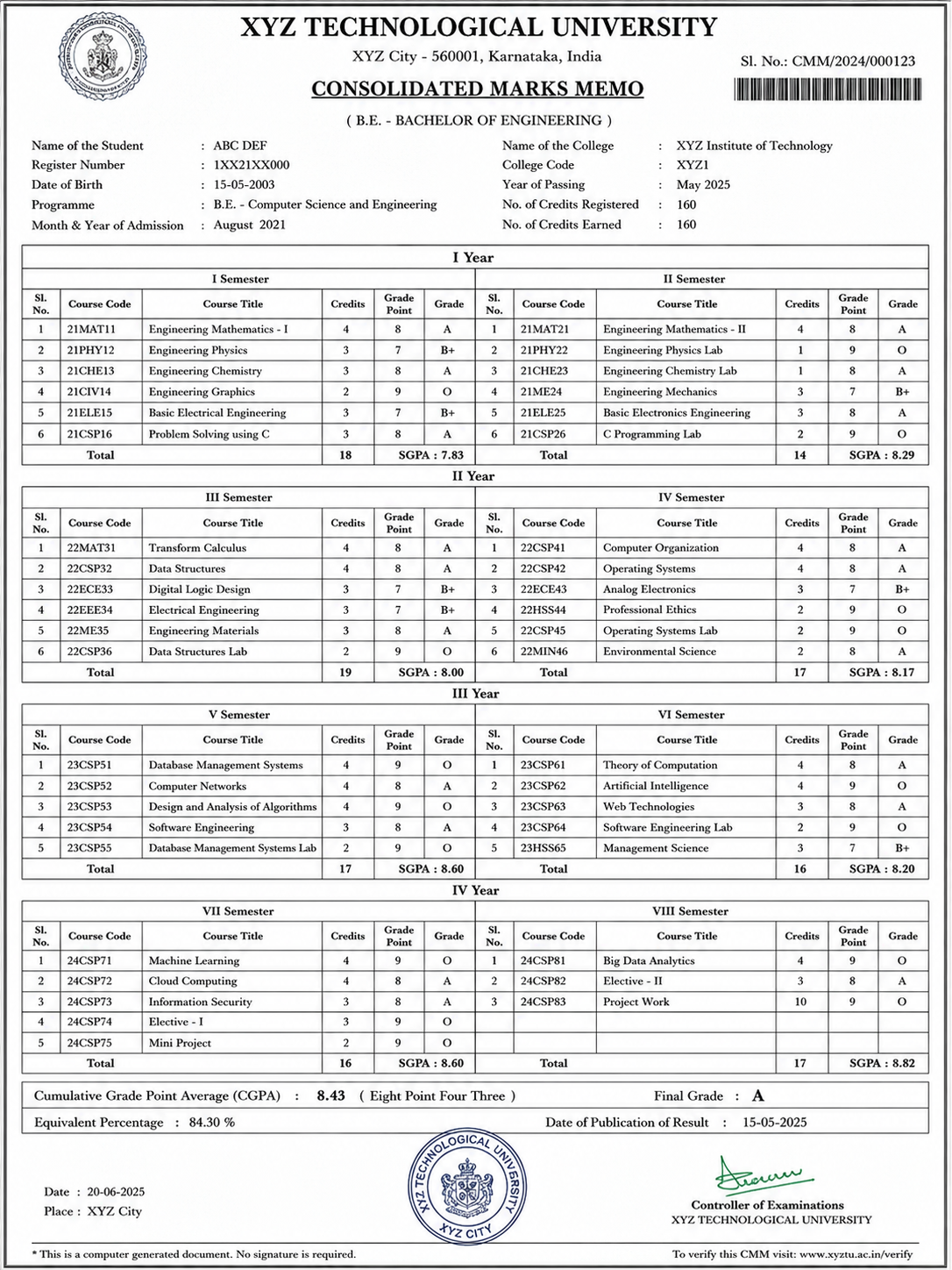
Consolidated Marks Memo (CMM) Sample

A Consolidated Marks Memo (CMM) follows a standard format that includes your personal details, course information, semester-wise marks, credits, and final CGPA, along with the university's official seal and authorised signature.

How to Get a Consolidated Marks Memo?

You can get a Consolidated Marks Memo (CMM) by applying to your university after your final semester results are declared and completing the required document verification. 

Follow the steps below to get your consolidated marks memo without unnecessary delays.

  • Step 1: Check your eligibility: Make sure you have completed all semesters and cleared every subject. Universities usually do not issue a CMM if any results or backlogs are pending.
  • Step 2: Submit your application: Apply through your university's examination portal or examination cell. Some autonomous colleges may also accept offline applications.
  • Step 3: Upload or submit the required documents: Provide your completed application form, ID proof, all semester marksheets for verification, and a passport-size photograph if required.
  • Step 4: Pay the processing fee: The fee ranges from ₹200 to ₹1,000, depending on the university. Urgent or tatkal processing may cost more.
  • Step 5: Wait for verification: The university verifies your academic records before issuing the CMM. Processing takes 2 to 6 weeks, although timelines vary by university.
  • Step 6: Collect your consolidated marks memo: Receive the document as a physical copy with the official seal or a digital copy with a QR code, depending on your university. If required for study abroad, get it attested before submitting it to foreign universities.

Consolidated Marksheet vs Individual Semester Marksheet vs Transcript

A Consolidated Marksheet combines your results from all semesters into one document, an individual semester marksheet shows the results of a single semester, and an academic transcript provides a detailed academic record for evaluation by universities and credential assessment agencies.

The table below compares a Consolidated Marksheet, an individual semester marksheet, and a transcript to help you understand when each document is required.

Feature

Consolidated Marksheet (CMM)

Individual Semester Marksheet

Transcript

What it shows

Marks or grades from all semesters, along with the final CGPA or overall percentage, in one document

Marks or grades for one semester only

A complete academic record with all subjects, credits, grading scheme, and repeat attempts, if applicable

Issued by

University after course completion

University or college after each semester

University on request

Main purpose

Confirms your overall academic performance after completing the degree

Records your performance in an individual semester

Supports academic evaluation, admissions, and credential assessments

Validity

Permanent academic record

Permanent academic record for that semester

Permanent academic record

When you need it abroad

Admissions, job verification, and government applications

Only if specifically requested by a university or evaluation agency

International admissions, credit transfers, and credential evaluations, such as WES or IQAS

Tips to Get a Consolidated Marksheet Faster

You can get your Consolidated Marksheet faster by applying through your university's online portal and ensuring your records are complete before submitting the request. Small mistakes or pending verifications often cause the biggest delays.

Here are some practical tips to help you receive your Consolidated Marksheet faster after applying:

  • Apply through the university's online portal: If your university offers online applications, use them instead of offline submissions, as they are usually processed faster.
  • Clear all pending dues beforehand: Settle any library, hostel, tuition fee, or other institutional dues before applying, as pending payments can delay document verification.
  • Keep all supporting documents ready: Prepare scanned copies of your semester marksheets, ID proof, and provisional certificate (if applicable) before starting the application.
  • Match your academic details exactly: Enter your name, roll number, registration number, and programme details exactly as they appear in your university records to avoid rejection or re-verification.
  • Apply soon after the final results are declared: Submit your application as soon as your university opens the application window to avoid longer processing times during peak admission and convocation periods.

From the Desk of Yocket

A missing or incorrect academic document can delay your university application, even if you meet every eligibility requirement. Before applying, check whether your university asks for a Consolidated Marks Memo, transcript, or both. Keeping attested copies ready can also save you time during admissions and visa processing.

Yocket Premium helps you prepare every document needed for your study abroad application with expert guidance at every step. From university shortlisting and application support to document reviews and visa assistance, our counsellors help you submit a complete and error-free application.

Frequently Asked Questions on Consolidated Marks Memo (CMM)

Is a Consolidated Marks Memo mandatory for studying abroad?

Can I apply for a Consolidated Marks Memo if I have backlogs?

Can I get multiple copies of my Consolidated Marks Memo?

Is a digital Consolidated Marks Memo valid?

Can I use a Consolidated Marks Memo instead of individual semester marksheets?

More Topics

Check your Eligibility at 2000+ Universities

Articles you might like

Check your Eligibility at 2000+ Universities