Exams Know-how

dMAT Practice Questions with Solution (2026)

Author_Image
Fiona
8 mins
801 views
Summarise with AI

The dMAT (Digital Master Test) was introduced by APS India in June 2026 as a new academic aptitude test for Indian students applying to Master's degree programmes in Germany. It assesses skills such as logical reasoning, problem-solving, and academic understanding through the Core Module and Subject Module.

Since the dMAT is a relatively new exam, there are no previous year papers or official sample papers available yet, unlike established tests like the GRE or GMAT, where years of past papers exist for practice.

To help you prepare anyway, we've prepared dMAT sample questions built exactly around the test structure, so you can get a feel for the question types and difficulty level before test day.

What is the dMAT Exam?

The dMAT (Digital Master Test) is a standardised test managed by g.a.s.t. for certain Indian students applying to Master’s programmes in Germany from the Summer Semester 2027 intake. 

It forms part of the APS India verification process and is designed to assess how well you apply reasoning and analytical skills to different types of problems. The test has a Core Module and a Subject Module, with the complete test taking about 3.5 hours, including a break.

Who Needs to Take the dMAT?

You need to take the dMAT if you're an Indian student applying for a Master's programme in Germany from the Summer Semester 2027 intake onward, and your undergraduate degree falls into one of these fields:

  • Engineering (BTech, BE, or related backgrounds)
  • Commerce, Finance, and Economics (Accounting, Economics, Finance)
  • Business and Management (BBA, BCom-based management routes)

If your undergraduate programme is interdisciplinary, for example Business Analytics, Industrial Engineering, Data Science, or Financial Technology, check your classification against the official APS list of affected fields, since these can fall on either side of the requirement depending on how they're categorised.

The dMAT does not replace your APS certificate. It's an additional requirement layered on top of the existing APS verification process, and your APS documentation isn't considered complete without it if you fall into an affected category.

dMAT Exam Format (2026)

The dMAT exam has two modules: the Core Module and the General Academic Module. The Core Module tests logical and visual reasoning through three question types, while the General Academic Module tests your ability to understand and apply information from academic material.

dMAT's Core Module and General Academic (or Subject) Module are scored separately, then combined into a single scaled score, reported with a mean around 100 and a percentile rank, so you can see how your performance compares to other test-takers rather than just an isolated number. A low score doesn't automatically disqualify your application, it's one data point APS considers alongside the rest of your profile, not a hard cutoff.

Here is an overview of the dMAT exam structure:

Module

Number of Questions

Duration

Structure

Core Module

60 questions (20 per subtest)

90 minutes

3 subtests (25 minutes each): Figure Sequences, Mathematical Equations, Latin Squares

General Academic Module

Not officially specified

90 minutes

Required for APS, or a subject-specific test (CS, Physics, Chemistry, EE, ME, Data Science)

Explore Destinations
Explore All Guides

dMAT Sample Questions with Answers: Core Module

The dMAT Core Module tests your logical thinking, pattern recognition, and problem-solving skills. It's the same for every applicant, regardless of your academic background, and includes three question types. These questions don't test your subject knowledge; they measure how quickly and accurately you can identify patterns and solve problems.

A. Figure Sequences

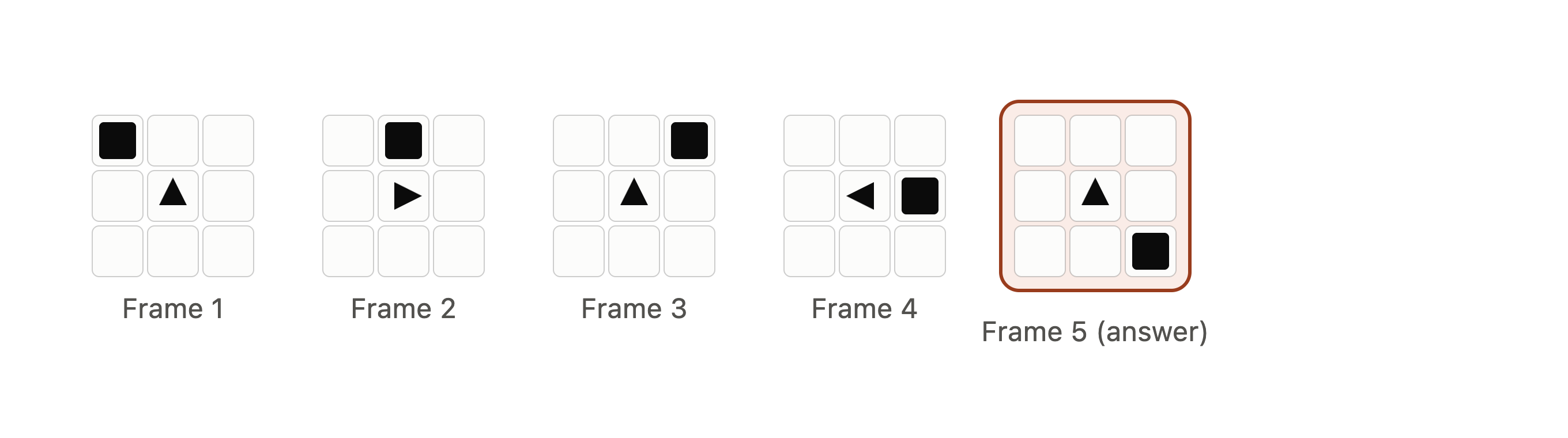
Sample Question 1(Difficulty: Low): A black square sits in the top-left corner of a 3×3 grid. In each new picture, it moves one step clockwise around the eight outer cells. A small arrow in the centre turns 90 degrees clockwise each time and starts by pointing up. Where is the square, and which way does the arrow point, in the fifth picture?

Answer: The square is in the bottom-right corner, and the arrow points up. The square moves one outer cell clockwise in each picture, so it goes from top-left to top-centre, top-right, right-centre, and then bottom-right. The arrow completes four 90-degree turns, which brings it back to pointing up.

Sample Question 2(Difficulty: Medium) A black circle starts in the centre of a 3×3 grid. In each new picture, it moves two steps clockwise around the eight outer cells, and its size alternates between small and large with every picture, starting small. What size and position does the circle have in the fourth picture?

Answer: Large, in the bottom-left corner. Starting from the centre, the first move places it on an outer cell; from there, two-step clockwise jumps land it on the bottom-left corner by the fourth picture. Since size alternates, starting small (picture 1 = small), picture 4 falls on a large iteration.

Tips to Solve Figure Sequence Questions

  • Focus on one pattern at a time instead of tracking every change together.
  • First identify how the shape moves, then check how other elements (colour, size, orientation) change.
  • Look for repeated movements, rotations, or size changes, and watch for rules that grow (move 1 field, then 2, then 3).
  • Practise visual reasoning questions regularly to improve your speed, since this subtest rewards fast pattern recognition over careful, slow analysis.

B. Mathematical Equations

Sample Question 1(Difficulty: Low): Every letter is a whole number between 1 and 20, and there is exactly one solution. Find A, B, and C.

A + B = 12 B = A + 2 C = A + B

Answer: A = 5, B = 7, and C = 12. Replace B with A + 2 in the first equation: A + (A + 2) = 12, so 2A = 10, A = 5. Then B = 7, and C = 12.

Sample Question 2(Difficulty: Low) Every letter is a whole number between 1 and 20, and there is exactly one solution.

A + 6 = 13; B − 4 = A. Find A and B.

Answer: A = 7, B = 11. Equation 1 has only A: A = 13 − 6 = 7. Substitute into equation 2: B − 4 = 7, so B = 11.

Tips to Solve Mathematical Equation Questions

  • Start with the equation that involves only one unknown; that's always the fastest entry point.
  • Substitute known values step by step instead of solving everything at once.
  • Keep calculations simple, since calculators and rough sheets aren't allowed; you're solving this mentally.
  • Check your final values against every equation before choosing your answer; a single arithmetic slip changes every downstream value.

C. Latin Squares

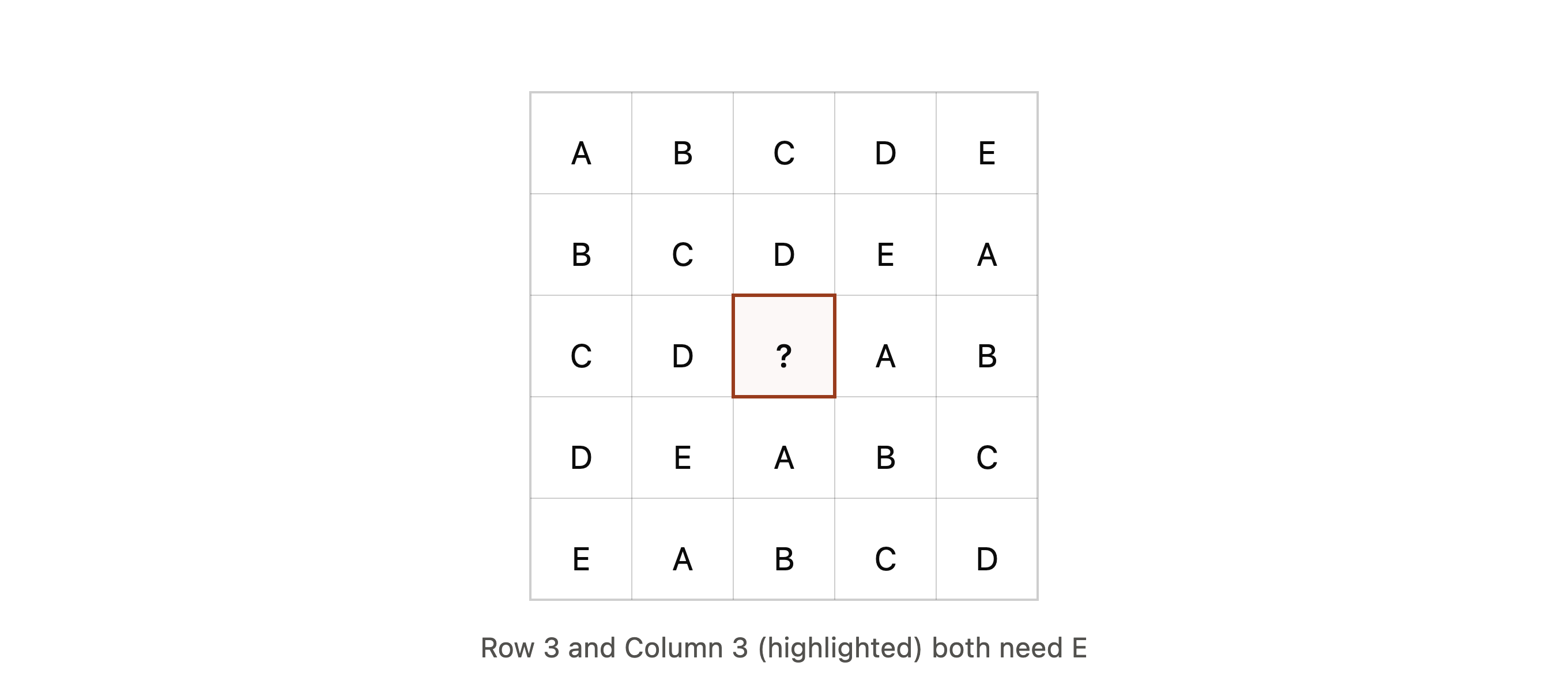
Sample Question 1(Difficulty: Low) Each letter A to E appears exactly once in every row and every column. Which letter belongs in the highlighted cell, given that Row 3 already contains C, D, A, and B, and Column 3 also contains C, D, A, and B?

Answer: E. Row 3 is missing only E, and Column 3 is missing only E too, confirming the answer.

Sample Question 2(Difficulty: Medium) In a 5×5 grid where each letter A to E appears once per row and column, Row 2 currently contains B, D, E, and A (one cell empty), and the same empty cell's column contains C, A, E, and D (one cell empty, the same cell). Which letter belongs in that cell?

Answer: Row 2 is missing only C. The column is missing only B. Since a single cell can only hold one letter, you'd need to check the actual grid to confirm which constraint applies; this is exactly why, on the real exam, you should always verify your answer against both the row and the column before finalising it, since relying on just one can lead you to the wrong letter if you misread the grid.

Tips to Solve Latin Square Questions

  • Find a row or column with only one missing value first; that's your fastest win.
  • Eliminate letters that already appear in the same row and column before guessing.
  • Confirm your answer by checking both the row and the column, not just one.
  • Avoid solving the entire grid when only one cell is required; that wastes time you don't have in a 25-minute subtest.

dMAT Sample Questions with Answers: General Academic Module

The dMAT General Academic Module is the standard module used for the APS certificate process for most Indian applicants. It presents short passages, scenarios, or data, followed by single-choice questions that test how well you analyse and apply information rather than memorise facts.

A. Quantitative Reasoning

Sample Question: A delivery service charges a fixed fee of 40 plus 8 for every kilometre travelled. One delivery is billed at 120 in total. How far was the delivery?

(a) 8 km
(b) 10 km
(c) 12 km
(d) 15 km

Answer: (b) 10 km. Subtract the fixed fee first: 120 − 40 = 80. Then divide by the charge per kilometre: 80 ÷ 8 = 10 km.

Tips: Read the entire scenario before calculating. Identify the relationship between the numbers first. Set up one simple equation instead of making multiple calculations. Focus on applying the information given rather than remembering formulas.

B. Natural Sciences

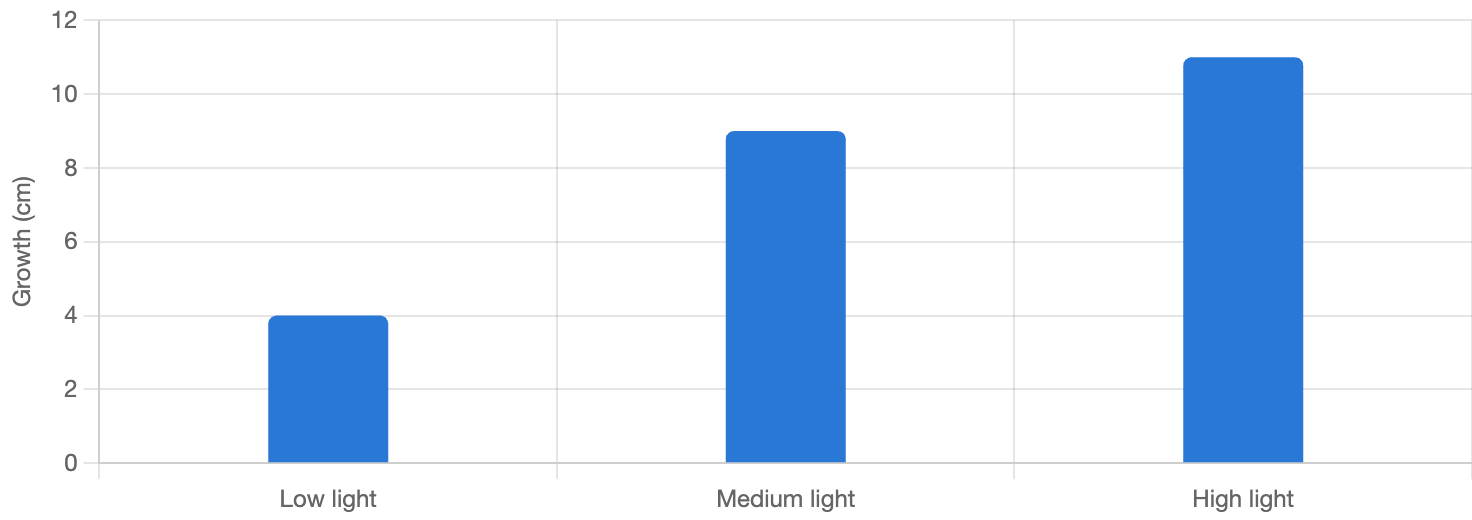
Sample Question: A plant is grown under three light levels for two weeks. Low light: 4 cm. Medium light: 9 cm. High light: 11 cm. Which conclusion does the data best support?

(a) Light does not affect growth
(b) Growth increases with more light, but the increase becomes smaller
(c) Low light is best for growth
(d) Growth doubles at every light level

Answer: (b). Growth increases from 4 cm to 9 cm and then to 11 cm. Although the plant grows more with higher light, the increase becomes smaller at each stage.

Tips: Study the data before reading the answer choices. Choose the conclusion that is directly supported by the information. Ignore options that make assumptions beyond the given data. Base your answer only on the evidence provided.

C. Business and Economics

Sample Question: A cafe sells 200 cups of coffee each day at 50 per cup. It increases the price to 60, and daily sales fall to 180 cups. Did the price increase improve daily revenue?

(a) No, revenue fell (b) Yes, revenue increased (c) Revenue stayed the same (d) It cannot be calculated

Answer: (b). Before: 200 × 50 = 10,000. After: 180 × 60 = 10,800. Daily revenue increased by 800.

Tips: Calculate the values before and after the change. Don't assume that lower sales always reduce revenue. Use the numbers in the question instead of relying on general business knowledge. Check your calculations before selecting an answer.

D. Social Sciences

Sample Question: A survey finds that students who sleep for more than seven hours report higher exam scores. A news article claims this proves that sleep causes better grades. What is the main weakness in this conclusion?

(a) The sample was too large (b) It assumes that a relationship proves cause and effect (c) Sleep cannot be measured (d) Exam scores are always accurate

Answer: (b). The survey shows a relationship between sleep and exam scores, but it doesn't prove that one causes the other. Other factors, such as study habits or lifestyle, could influence both.

Tips: Focus on the logic behind the argument. Look for conclusions that confuse correlation with causation. Choose the answer that best identifies the weakness in the reasoning. Base your decision only on the information given in the passage.

How to Practice dMAT Sample Questions?

The Core Module is split into three subtests, and each one runs on its own clock: roughly 20 questions in 25 minutes per subtest. That's about 75 seconds per question, so speed matters as much as accuracy.

When you practise the dMAT sample questions, don't just check whether you got the right answer. Time yourself against the real pace (aim for under 75 seconds per question), and since there's no negative marking, always select an answer even if you're unsure, a guess costs you nothing, but a blank answer guarantees zero.

From the Desk of Yocket

One of the biggest challenges with the dMAT is that there are no previous year papers to practise from. Since the exam is new, many students spend time searching for past questions instead of learning the different question formats. Your preparation should focus on understanding how each question type works, practising under the real 75-second-per-question pace, and improving your speed through regular timed practice. This approach will help you feel more confident on exam day.

If you are planning to study in Germany, Yocket Premium can simplify your application journey. Our experts help you shortlist universities, plan your APS and dMAT timeline, prepare your documents, and complete your applications before the deadlines. With personalised guidance at every step, you can stay organised and avoid last-minute stress.

Frequently Asked Questions on DMAT Sample Questions and Answers

When was the dMAT introduced?

Are dMAT sample questions repeated in the actual exam?

Is there negative marking in the dMAT?

Can I use a calculator or rough sheet during the dMAT?

How many practice questions should I solve before the dMAT?

More Topics

Check your Eligibility at 2000+ Universities

Articles you might like

Check your Eligibility at 2000+ Universities