



Application documents

What is an Academic Transcript?

Author_Image
Kashyap Matani
6 mins
174.5k views
Summarise with AI

An Academic Transcript is an official academic record issued by a university or college that includes your educational performance throughout a program. It mentions your semester-wise subjects, grades, credits earned, GPA or CGPA, and degree details. 

Academic Transcripts are commonly required for university admissions, student visa applications, scholarships, and credential evaluations, making them one of the most important documents in the study abroad process.

star icon
Key Highlights

What is an Academic Transcript?

Universities issue academic transcripts as an official record of your academic performance. They give universities abroad a standardised way to evaluate your grades, coursework, and academic progress, regardless of differences in grading systems and curricula across countries.

What is a Transcript of Records (ToR)?

A Transcript of Records (ToR) is an official Academic Transcript that lists all the courses you've completed, the credits earned, and the grades you received. It also includes your personal details, your institution's grading scale, and other academic information. 

If you've graduated, your Transcript of Records will also show your final degree classification. Since it is issued and authenticated by your university with an official signature or seal, it is accepted as a valid academic document for study abroad applications.

Types of Academic Transcripts

As a study abroad applicant, you'll come across three types of Academic Transcripts: Official, Unofficial, and Evaluated Transcripts. Each serves a different purpose during the application process.

  1. Official Academic Transcript: Issued on your institution's letterhead, signed by the registrar, and authenticated with an official stamp or seal. This is the version accepted for university admissions, employment, and professional licensing.
  2. Unofficial Academic Transcript: A copy or download from your student portal that contains the same academic information but does not include an official signature or seal. It is useful for personal reference or initial applications but is not accepted for final document submission.
  3. Evaluated Academic Transcript: An official transcript assessed by a credential evaluation agency, such as WES, to convert your grades and credits into the grading system of another country. Some universities require an evaluated transcript to compare your academic performance with their local standards.
Explore Destinations
Explore All Guides

What is the Purpose of Academic Transcripts?

An Academic Transcript serves as an official record of your academic performance, helping universities, employers, and other organisations verify your educational qualifications. 

Here's where an Academic Transcript is commonly used:

  • Higher Education Admissions: Colleges review your transcript to check your GPA, verify prerequisite courses, and evaluate your academic profile during the admissions process.
  • Credit Transfers and Study Abroad: Universities compare your completed courses and credit values to determine whether you're eligible for credit transfers or course exemptions.
  • Employment and Professional Licensing: Employers and professional licensing bodies, such as medical and engineering councils, use transcripts to verify that you meet the required educational qualifications.
  • Scholarships and Fellowships: Scholarship providers require official transcripts to check your academic performance before awarding financial aid.
  • Student Visa Applications: Visa authorities might ask for your Academic Transcripts to verify your educational background and support your student visa application.

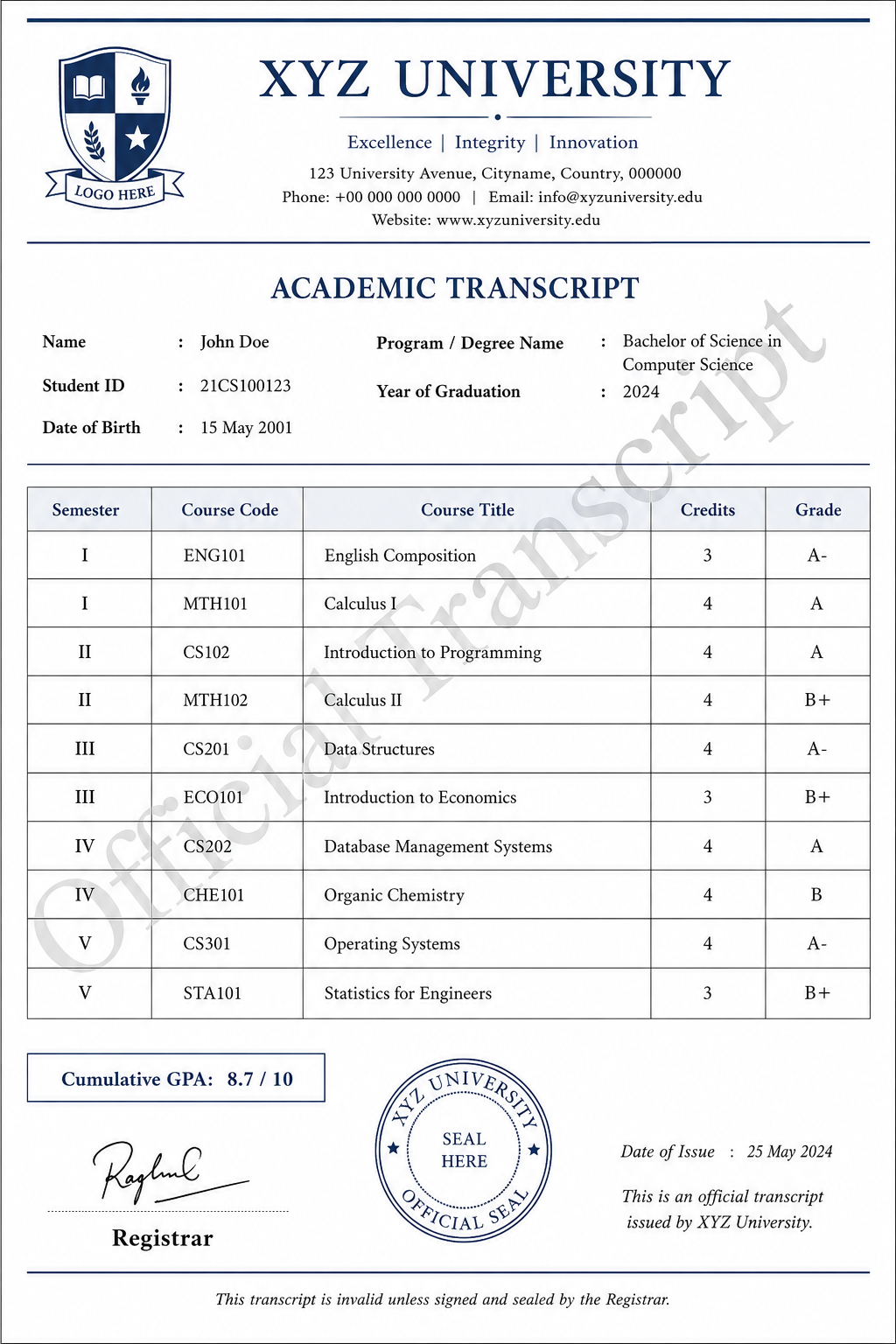
Sample Academic Transcript

A typical Academic Transcript includes your semester-wise subjects, grades, credits, and your institution's official seal, as shown below.

Documents Required Along with Academic Transcripts

Academic Transcripts are submitted along with other application documents that help universities verify your academic qualifications, identity, and eligibility for admission.

Here is the checklist of documents you should keep ready, though requirements differ across universities:

  1. Application Form: A completed university application or document submission form, as required by the institution.
  2. ID Proof: A valid passport or other government-issued ID for identity verification.
  3. Mark Sheets: Semester-wise or consolidated mark sheets to support the information on your transcript, if requested.
  4. Degree Certificate (if applicable): Required if you've already completed your undergraduate or postgraduate degree.
  5. Statement of Purpose (SOP): Many universities require an SOP alongside your academic documents to understand your academic background and career goals.
  6. Letters of Recommendation (LORs): Academic or professional recommendations, where applicable, to strengthen your application.
  7. English Language Test Scores: Valid IELTS, TOEFL, PTE, or other accepted test scores, if required by the university.
  8. Standardised Test Scores (if applicable): GRE, GMAT, SAT, ACT, or other entrance test scores, depending on the programme and university.

How is a Transcript Different from Marksheet, Certificate, Diploma and Degree?

A transcript covers your entire academic history, while a marksheet shows a single term, a degree confirms graduation, a diploma is the physical certificate, and a certificate validates a specific skill or short course.

The table below compares transcripts, marksheets, degrees, diplomas, and certificates:

Document

What It Is

What It Shows

Primary Usage

Transcript

A comprehensive, authenticated record of your academic history

Every course, grade, credit, and overall GPA across all semesters

Study abroad admissions, student visa applications, and credential evaluations such as WES

Marksheet

A record of your performance in a single semester or annual examination

Subjects and grades for a specific semester or academic year

Tracking semester-wise performance and subject-level verification

Degree

An official qualification awarded after completing a programme

Degree title and field of study; does not include grades or coursework

Proof of educational qualification for higher education and employment

Diploma

The physical qualification awarded after completing a programme, or a qualification for certain vocational programmes

Proof of course completion

Used as proof of qualification; in some countries, the term is used interchangeably with a degree, while in others it refers to vocational education

Certificate

A document awarded for completing a short-term or non-degree course

Completion of a specific skill, course, or training programme

Professional development, skill enhancement, and specialised training

Which Transcripts are Needed for Different Courses?

The transcripts required for different courses depend on the level of study you're applying for. In most cases, universities ask for transcripts from your highest completed qualification or your most recent level of education.

Here's a breakdown of the transcripts required for different courses and levels of study:

  1. Undergraduate courses: Official transcripts from Class 9-12, including your final examination scores and overall academic performance.
  2. Postgraduate courses: A complete, semester-wise bachelor's degree transcript, or an interim transcript if you're in the final year of your undergraduate programme.
  3. Diploma and certification courses: Transcripts from your highest completed qualification, whether that's high school or a previous undergraduate degree.
  4. Submission format: Most universities require official transcripts issued or sealed by your institution's registrar. While some accept unofficial transcripts during the initial application stage, official transcripts are required before admission is confirmed.

How to Get a Transcript Certificate?

To get a transcript certificate, you must apply through your university's Registrar's Office or Examination Cell and submit your mark sheets along with the request. 

Here are the steps you should follow to get your transcript without delays:

  • Step 1: Identify the right office. Transcripts are issued by your university's Registrar's Office, Academic Affairs Department, or Examination Cell, not your individual department.
  • Step 2: Apply online or in person. Many universities now offer online transcript portals where you can log in and apply directly. If your institution doesn't, visit the admin block and collect the physical request form.
  • Step 3: Submit your supporting documents. Attach your semester mark sheets, degree or provisional certificate, course completion letter, and a valid ID proof along with your application.
  • Step 4: Pay the processing fee. Transcript fees usually range from ₹1,500 to ₹5,000, depending on the number of copies and whether you need international postage.
  • Step 5: Choose your delivery format. Decide between a sealed physical copy sent by post or a secure digital copy sent directly to you or the receiving university.
  • Step 6: Apply early and request extra copies. Processing can take up to 21 working days, so apply well in advance and order 3 to 4 sealed copies if you're applying to multiple universities.

What is the Importance of a Certified Academic Transcript?

A certified Academic Transcript is an official, verified record of your academic performance issued by your institution. It carries an authorised signature and official seal, making it valid for admissions, credential evaluations, and other formal verification processes.

Here's why a certified Academic Transcript is important:

  • Confirms authenticity: A certified transcript is signed and stamped by an authorised university official, making it an authentic academic record rather than a self-downloaded copy or marksheet.
  • Builds credibility: Universities, employers, and visa authorities rely on certified transcripts to verify that your academic record is genuine and has not been altered.
  • Required for official verification: Unlike unofficial transcripts, certified transcripts are accepted for credential evaluations, university admissions, and other situations where your educational qualifications must be formally verified.
  • Supports secure document transfer: Certified transcripts can be sent directly by your institution to universities or credential evaluation agencies, ensuring they retain their official status throughout the application process.

From the Desk of Yocket

An Academic Transcript may seem like just another document, but a missing seal, the wrong transcript format, or a delayed request can hold up your university application. Since transcript requirements vary across institutions and countries, it's always a good idea to verify what your target universities expect before submitting your documents.

With Yocket Premium, you get expert guidance on every stage of your study abroad application; from creating a university-specific document checklist and reviewing your application to helping you stay on top of deadlines. That way, you can focus on securing admits instead of worrying about paperwork at the last minute.

Frequently Asked Questions about Academic Transcript

Is an Academic Transcript the same as a marksheet?

How do I get an Academic Transcript from my university?

Can I apply for an Academic Transcript online?

How long does it take to receive an Academic Transcript?

How much does an Academic Transcript cost?

Is an Academic Transcript mandatory for studying abroad?

Can I get a digital Academic Transcript?

What if there is an error in my Academic Transcript?

Is an Academic Transcript valid forever?

Can someone else collect my transcript on my behalf?

Is a sealed transcript necessary?

Can I use the same transcript for multiple university applications?

More Topics

Check your Eligibility at 2000+ Universities

Articles you might like

Check your Eligibility at 2000+ Universities