




A CAS letter is an important document for international students planning to study in the UK. The document confirms your acceptance at a UK university and allows you to apply for a student visa. Let's learn more about how CAS works, why you need it, and how to get one for your UK study journey.

Key Highlights
 A CAS letter is issued after you accept an unconditional offer from a UK university and are required to apply for a UK student visa, as it gives 30 visa points.
- A CAS letter for the UK is valid for six months from the date of issue and can be used only once to apply for a UK student visa.
- Most UK universities issue the CAS within 5 to 20 working days after document submission.
Table of Content
What is CAS?
CAS Full Form: CAS stands for Confirmation of Acceptance for Studies.
It is an electronic document that your chosen UK university sends you after you accept an unconditional offer and pay the initial deposit.
A CAS letter contains a unique 14-digit alphanumeric code called a CAS number that stores all your personal details, course information, and university details on a secure government database.
Why is the Purpose of the CAS Letter?
The CAS letter is a critical part of your UK student visa process, as it directly determines your eligibility to apply.
Here’s why it matters:
- Mandatory for a Visa Application: You cannot submit a UK student visa application without a valid CAS, as it contributes 30 out of the 40 points required under the UK visa points system.
- Confirmation of Admission: It officially confirms that a UK university has offered you a full-time course and agreed to sponsor your student visa.
- Verification by UKVI: The CAS number allows UK Visas and Immigration (UKVI) to verify your course, fees, and personal details against their records.
- Visa Extension Support: Existing students can use a new CAS letter to extend their stay when progressing to another course or academic level.
- Accuracy Check: It helps ensure consistency between your university records and visa application, reducing the risk of errors or refusals.
- Proof of Sponsorship: The CAS demonstrates that your university is an approved sponsor and has validated your academic and financial details.
Information Included in the UK CAS Letter
A CAS letter contains detailed information from your full name to language test scores that the UKVI needs to process your student visa application.
Here is what a UK CAS letter includes:
- Personal Details: Your full name, date of birth, nationality, passport number, and contact information exactly as per your passport.
- CAS Number: A unique 14-digit alphanumeric reference code assigned specifically to you that remains valid for six months from the issue date.
- University Information: The name of your university, its sponsor license number, and its complete contact details.
- Course Details: The name of your program, start and end dates, course level (undergraduate, postgraduate, or research), and whether it is full-time or part-time.
- Course Fees: The total tuition fees for your program and any amounts you have already paid as deposits.
- Accommodation Details: Information about where you will live during your studies, if the university provides this information.
- English Language Proficiency Tests: Your IELTS, TOEFL, or PTE scores that prove you meet the language requirements.
- Financial Evidence: Confirmation of the funds you need to support yourself during your studies.
- Academic Qualifications: Details of your previous educational qualifications.
Explore Destinations
Explore All Guides 


How to Get a CAS Letter?
Getting a CAS letter for studying in the UK requires completing a few steps, like paying a tuition deposit and submitting important documents.
Here’s a step-by-step guide on how you can get a CAS Letter:
- Step 1: Receive an unconditional offer: You must meet all academic requirements, submit transcripts and certificates, and achieve the required English test scores.
- Step 2: Accept the offer and pay the tuition deposit: Confirm your seat by accepting the offer through the university portal and paying a deposit, between £2,000 and £5,000 (₹2.4 L to 6L).
- Step 3: Pre-CAS check: Universities verify that you are a genuine student. You may need to fill out an online form or attend an interview about your course, career goals, and reasons for studying in the UK.
- Step 4: Submit required documents: Provide your passport, academic transcripts, English language certificates, financial documents, and tuberculosis test certificate (if from India).
CAS Letter Sample for the UK
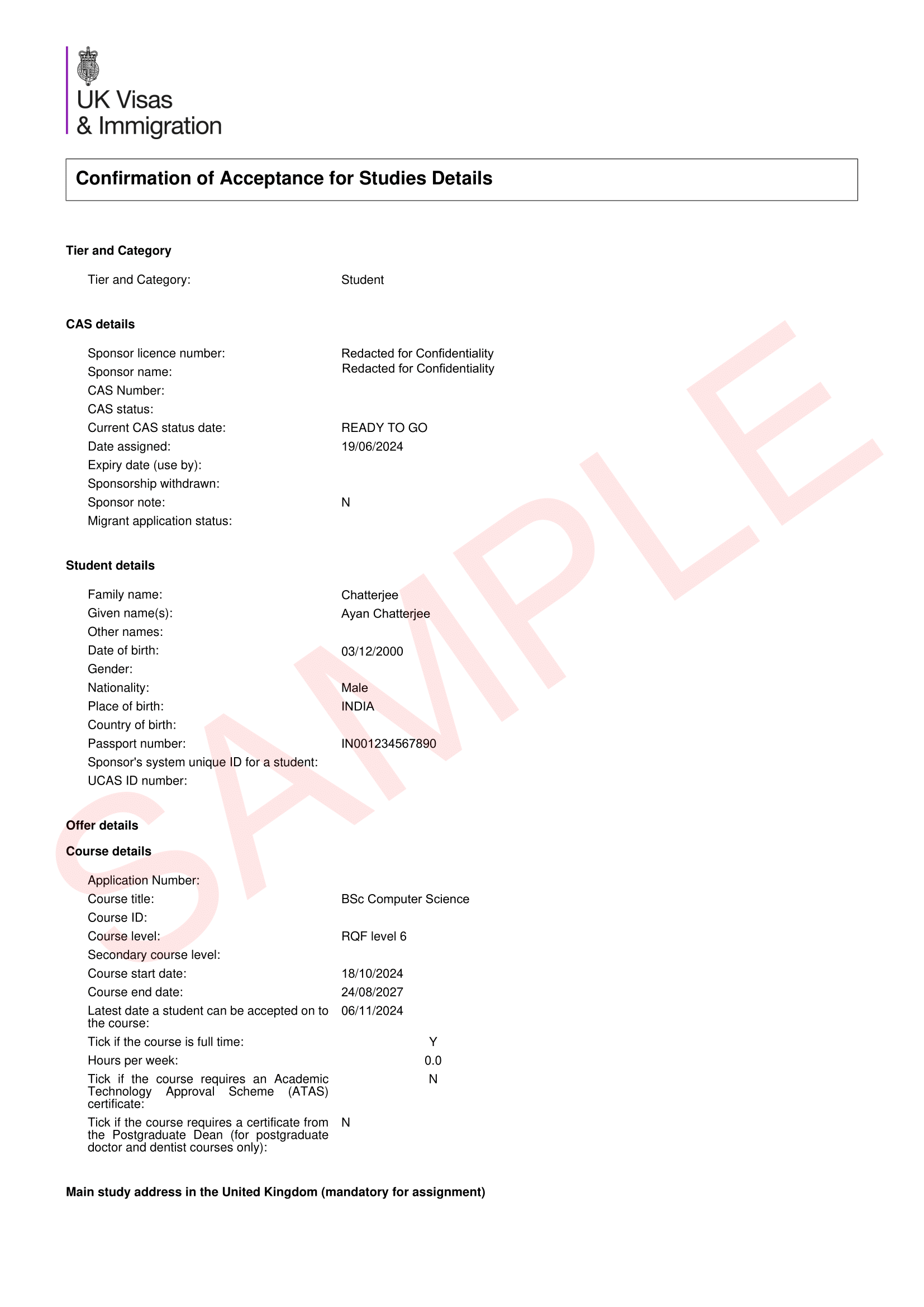
Now, you might have an idea of what CAS includes, but it is crucial to know what it actually looks like as a physical copy.
Here is the sample of the UK CAS Letter:
CAS Letter Issuing Procedure
UK Universities issue CAS letters only after they carefully check all your details and documents. They enter your personal details, course information, and financial proof into the official UK visa system. After this, they create a unique CAS number and email you a CAS statement with all the details shared with the Home Office.
UK CAS Letter Requirements for Indian Students
Indian students must meet a few clear requirements, like valid transcripts and an unconditional offer, before a UK university issues a CAS letter.
Each step below helps the university confirm that you are ready to study and apply for a visa:
- Unconditional offer: You must have an unconditional offer, which means all academic and English language conditions are already cleared.
- Tuition deposit payment: You need to pay the required deposit to secure your seat, as mentioned above.
- Valid passport: Your passport should be valid for at least six months from your course start date.
- Academic transcripts: Submit certified copies of your mark sheets, certificates, and degree documents.
- English language certificate: Provide valid IELTS, TOEFL, or PTE scores that meet your course requirements.
- Financial evidence: Show bank statements or an education loan letter proving you can afford tuition and living costs for one year.
- TB test certificate: Indian students must submit a TB test certificate from a Home Office-approved clinic.
- Pre-CAS interview clearance: Some universities ask for a short interview to check your study plans.
CAS Letter Processing Time
The processing time for the CAS letter typically ranges from 5 working days to 3–4 weeks, depending on the university and the intake period.
Universities process applications faster during off-peak periods but sometimes take longer during busy admission time between June and August. But most of the colleges try to issue the letter within 10 working days after your submission.
CAS Letter UK Validity
A CAS letter remains valid for six months from the date your university issues it to you. You must apply for your UK student visa within this six-month window, and you can only use the CAS number for one visa application.
UK CAS Interview Questions and Answers
Many UK universities conduct interviews before issuing CAS letters to verify student credentials and genuine study intentions.
The following UK CAS questions and answers will help you understand what sort of things can be asked about you:
Q1: Tell us about yourself and your education.
Start with your name, hometown, and what you are doing now. Briefly mention your degree, subject, and any work experience related to the course.
Q2: Why do you want to study in the UK?
Talk about real benefits like shorter courses, global degree value, and practical learning. Focus on how this helps your career, not just the country.
Q3: Why did you choose this university?
Mention specific reasons such as course subjects, teaching style, rankings, or industry links. Showing research makes your answer stronger.
Q4: Why did you choose this course?
Connect the course with your past studies or work experience. Explain how the subjects will help you reach your career goals.
Q5: What are your plans after this course?
Share clear career goals and how the degree fits into them. You can mention plans to return to India or work globally.
Q6: How will you pay for your studies?
Clearly explain your funding source, such as family savings, a loan, or a scholarship. Your answer must match the financial documents you submitted.
Q7: Have you applied to other universities?
Be honest and explain why you chose this one. This shows you made a planned and thoughtful decision.
Q8: Have you ever faced a visa refusal?
Always answer truthfully. If yes, explain the reason and what you have improved since then.
Q9: Do you have family in the UK?
Share correct details if you have relatives in the UK. Being honest avoids problems later.
Q10: What do you know about your university city?
Talk about the city, job options, transport, and student life. This shows you have properly planned your stay.
Common Reasons for CAS Rejection
A UK university may refuse to issue a CAS letter if your financial proof is weak or your documents do not match correctly.
Below are the most common reasons why a CAS letter gets rejected:
- Weak financial proof: Your bank statements do not show enough money, are older than 28 days, or have large unexplained deposits. This makes the university doubt whether you can afford your studies.
- Details do not match: Your name, dates, or other details are different across documents like passports, mark sheets, or bank statements.
- Poor pre-CAS interview performance: You are unable to clearly explain why you chose the course or your future plans. This makes the university unsure about your genuine intention to study.
- Missing or late documents: Important documents like English test scores, transcripts, passport copy, or TB report are not submitted on time.
From the Desk of Yocket
Applying for a CAS letter can feel confusing when deadlines are approaching and documents must be perfect. Many students lose time due to small mistakes like mismatched details or weak financial proof, which can delay their UK study plans.
This is where Yocket Premium can make things easier. With expert guidance, document checks, and interview preparation, you get step-by-step support to avoid CAS delays and move closer to studying in the UK with confidence.